In short
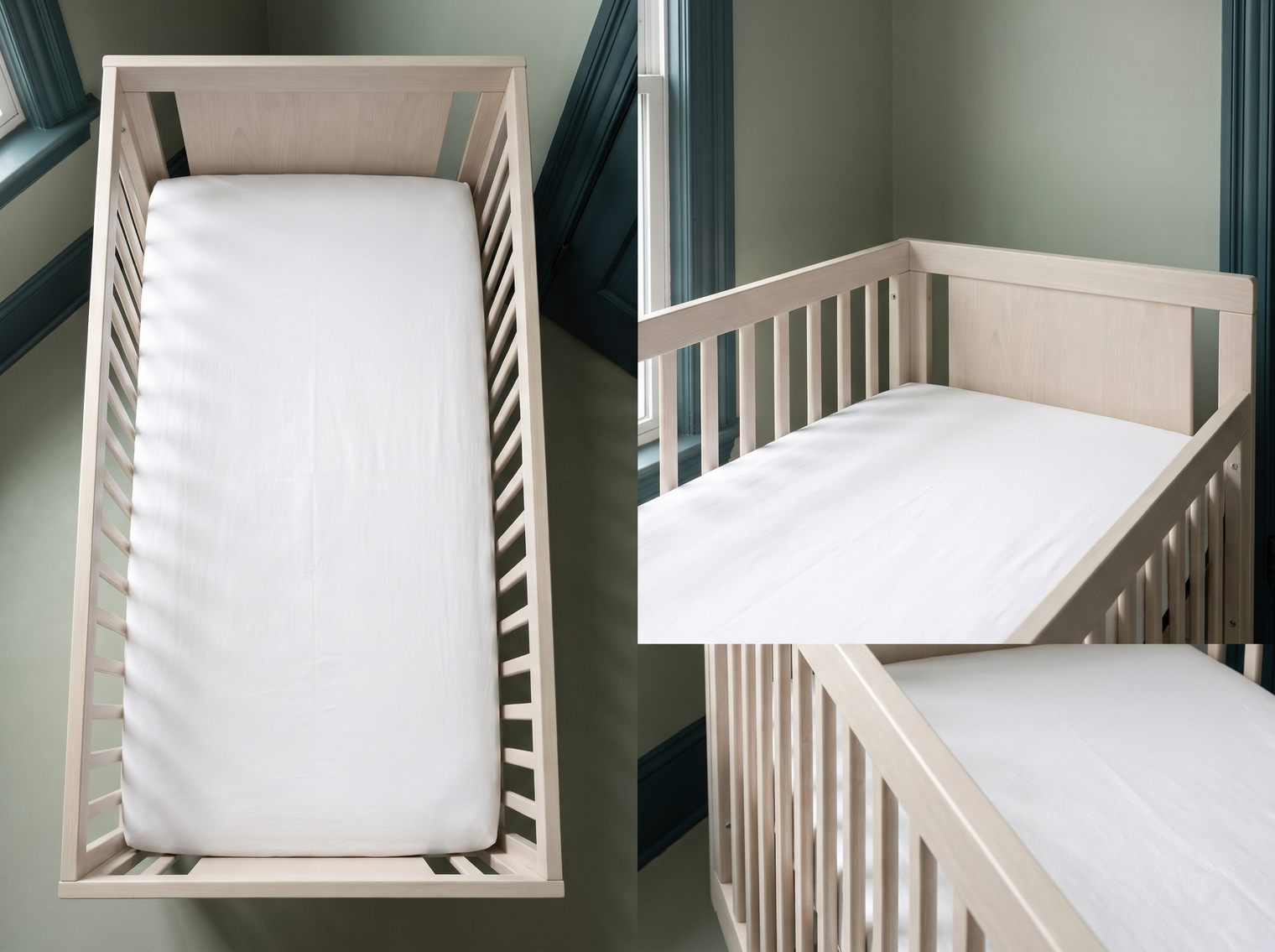
Crib and toddler bedding counts as non-toxic when the finished fabric passes limits written for young children rather than adults. Babies breathe more air for their weight and suck on cloth, so the limits get tighter. OEKO-TEX's baby class requires formaldehyde to stay below 16 mg/kg (TextileSchool, 2026) and dyes that hold up in saliva (OEKO-TEX FAQ). US law caps lead at 100 ppm in children's products (CPSC). Under age one, a crib should hold a fitted sheet and nothing else.
This guide is for: parents, grandparents and gift buyers in the United States who are reading crib and toddler bedding labels.
Key Takeaways
- OEKO-TEX puts textiles for children up to 36 months in Class I (OEKO-TEX STANDARD 100, Hohenstein copy). In that class formaldehyde must be not detectable (under 16 mg/kg), compared with 75 mg/kg for adult skin-contact textiles (TextileSchool, 2026).
- US law limits lead to 100 ppm in any accessible part of a children's product (CPSC), and padded crib bumpers have been banned since November 12, 2022 (CPSC).
- Of 14 crib sheet product pages we read on 2026-11-17, 7 named only GOTS, the Global Organic Textile Standard, which certifies organic fiber and its processing; 5 named GOTS plus a second certificate; and 2 named OEKO-TEX alone.
Why are chemical limits stricter for babies than for adults?
A baby takes in more of whatever a fabric carries, because it breathes more air for its weight, has thin skin, and mouths cloth.
The EPA says children eat more food, drink more water and breathe more air in proportion to their body weight than adults (EPA). The same page notes that infants have more permeable skin and higher breathing rates for their size. When you lay a baby on a sheet, the fabric is touching a small body that takes in more per pound than yours does.
Behavior adds another route. EPA's risk assessment page names crawling and hand-to-mouth activity as reasons children come into contact with more chemicals than adults (EPA). Your baby will chew the corner of a sheet. You rarely do, and that is why baby textile rules test for things an adult standard skips, such as whether a dye comes loose in saliva.
Development matters as well. That EPA risk page also says children's systems are still developing, which can leave them less able to break down and get rid of toxins. A dose you would clear without noticing can matter more to an infant who is still growing.
Taken together, the stricter limits give you a wider margin for a child who is smaller, breathes faster and is more exposed. They do not prove that adult bedding is unsafe for adults. The chemistry is the same, but it is judged against a smaller body and a curious mouth, so the allowed amount drops. The same reasoning runs through every standard below, from the voluntary OEKO-TEX baby class to the federal rules for children's products.
What do crib sheet listings say about certificates?
We read 14 crib sheet product pages. Half named only GOTS, the Global Organic Textile Standard, and none gave an OEKO-TEX class.
We read 14 crib sheet product pages on 2026-11-17. Every one was sold for the standard crib mattress. We noted only the certificates each page names in its own text. This is a count of what sellers publish, so nothing here was bought, handled or tested.
7 of the 14 named GOTS alone. 5 named GOTS plus a second chemical certificate, either MADE SAFE or OEKO-TEX STANDARD 100. 2 named OEKO-TEX alone.
| What the page names | Pages | Product pages read |
|---|---|---|
| GOTS alone | 7 | Moonybaby, Makemake Organics, Salt Earth, Jurassic Joy 3-pack, Bunnyjik, Delta Children, Naturepedic, Amazon listing |
| GOTS plus MADE SAFE or OEKO-TEX | 5 | Naturepedic sateen, Naturepedic muslin, Little Unicorn, KeaBabies, Woolino |
| OEKO-TEX alone | 2 | NODNAL, Amazon listing, NODNAL, Walmart listing |
No seller prints the fact you most need. None of the pages naming OEKO-TEX said, in the text we read, which product class the certificate covers. That matters because OEKO-TEX says its certificate shows that the listed articles meet the requirements of one product class (OEKO-TEX FAQ). A sheet certified under the adult skin-contact class passed a real test, but not the baby one.
You can fill that gap yourself. Before you treat a STANDARD 100 logo on non toxic crib sheets as a baby-grade result, ask the seller for the certificate and read the class on it. The GOTS-only pages raise a different question, covered below: an organic label is about fiber and processing, not a lab test of the finished sheet.
What does OEKO-TEX Class I require that adult bedding skips?
Class I covers textiles for children up to 36 months, bans formaldehyde finishes, and adds a saliva test for dyes and prints.
OEKO-TEX sorts every certified textile into four product classes based on how close it sits to the skin. Class I is for babies and toddlers up to three years old, and OEKO-TEX's own examples include bed linen and bedding (OEKO-TEX FAQ). The current standard keeps that same age line (OEKO-TEX STANDARD 100, Hohenstein copy).
Class I tightens the rules. Finishes that contain formaldehyde are excluded, and the formaldehyde limit falls to "not detectable." A summary of the current OEKO-TEX list gives the value that phrase stands for, shown in the table below (TextileSchool). Baby materials are also tested for color fastness in a synthetic saliva and sweat solution that imitates sucking, and the dyes have to score very high. Across the board, OEKO-TEX holds all baby articles to its strictest criteria (OEKO-TEX FAQ).
| Requirement | Class I: babies to 36 months | Class II: skin contact | Class IV: decoration |
|---|---|---|---|
| Free and releasable formaldehyde | Not detectable (under 16 mg/kg) | 75 mg/kg | 300 mg/kg |
| Color fastness to saliva and perspiration | Must be fast | Not applicable | Not applicable |
The formaldehyde values come from the current OEKO-TEX list as summarized by TextileSchool. The saliva rule comes from Portugal Clothing Factory's summary of the current list.
When you read a crib sheet label, remember that a Class II certificate is still a real test, but it was passed against the adult limits. Our guide to what OEKO-TEX STANDARD 100 tests bedding for covers the full list of what the standard checks and what it leaves out.
Which US federal rules apply to crib and toddler bedding?
Federal law caps lead in children's products, bans certain phthalates in child care articles, and outlaws padded crib bumpers outright.
OEKO-TEX is a choice a seller makes. The rules below are law, and they protect you whether or not a seller opts in to any certificate. The Consumer Product Safety Improvement Act covers products designed mainly for children (CPSC). A children's product with lead above the federal limit in any accessible part is a banned hazardous substance (CPSC). For plain fabric the burden is light, so you will rarely find a lead test report. CPSC has determined that textiles do not exceed the lead limit, which spares them a third-party lead test (Federal Register). The seller still has to certify compliance on a Children's Product Certificate.
Phthalates are softeners used in plastics and some coatings. CPSC bans child care articles that contain any of the listed phthalates above the limit in the table below (CPSC). The ban reaches plasticized parts (CPSC FAQ), so it matters more for vinyl-coated parts than for woven cotton.
Padded crib bumpers are banned by federal law, along with vinyl bumper guards and vertical slat covers (CPSC). A non-padded mesh liner is not covered.
| Federal rule | What it covers | Limit |
|---|---|---|
| Total lead content | Children's products for ages 12 and under | 100 ppm in any accessible part |
| Phthalates | Children's toys and child care articles | 0.1 percent of each listed phthalate |
| Crib bumper ban | Padded bumpers, vinyl bumper guards, slat covers | Banned outright |
You will still see bumpers in online listings, and CPSC keeps warning owners to throw them away. If an organic crib bedding set comes with one, it is illegal to sell, however clean its fiber.
Does organic crib bedding mean the same thing as non-toxic?
No. Organic describes how the fiber was grown and processed, while non-toxic is a claim about what the finished fabric still carries.
Searches for organic crib bedding and non toxic crib sheets often treat the two as one thing. They overlap. They are not the same. An organic label tells you about the farm and the mill: how the cotton was grown and which processing chemicals were allowed. A STANDARD 100 label tells you a lab tested the finished article against a list of restricted substances. Our guide to how GOTS, OEKO-TEX, GREENGUARD and MADE SAFE differ in what they check sets the four side by side.
You will find sellers who blur the line. One crib sheet page we read says its GOTS certificate means no GOTS-prohibited synthetic dyes and no formaldehyde-based finishes (Naturepedic). That is the seller's own reading of a processing standard. It is not a lab result on the sheet you are holding.
Several pages in our count named an organic certificate and a separate chemical certificate together. If you want both kinds of assurance, look for both names on the listing, then check the class on the chemical one.
Dye is the other half of what you are asking. An undyed sheet takes away the worry that a print will bleed under a baby's mouth, which is the exact risk the Class I saliva test exists for. A printed organic sheet can be sound. The organic label alone just does not tell you whether its dyes passed a saliva test, so you need the second certificate to know.
Why does a safe crib need so little bedding?
For a baby under one, the AAP advises a firm, flat mattress with a fitted sheet and nothing else, so the safest set is also the smallest one.
Chemistry is not the biggest risk you face in a crib. Suffocation is. The American Academy of Pediatrics recommends a firm, flat, noninclined surface covered by a fitted sheet with no other bedding or soft objects (AAP). The policy gives the reason: rolling into soft bedding is an important risk factor for sleep-related death, so the space should hold nothing but the sheet.
That changes what belongs in the set. A quilt, a pillow or a bumper does not become safe because it is sold as organic baby bedding. CPSC repeats the advice in its warnings: use a fitted sheet only, and never add blankets, pillows or padded bumpers (CPSC). If you worry about warmth, dress your baby in layers instead of adding cloth to the crib.
It also narrows your chemical question. With one fitted sheet on the mattress, the textile touching your baby all night is that sheet. That is where a certificate earns its keep, so check the sheet's class and dyes rather than buying more pieces.
Check the fit, too. The AAP says the mattress should keep its shape under the fitted sheet made for it, with no gaps between the mattress and the crib wall (AAP). Every sheet in our count was sold for the standard crib mattress size (Naturepedic), so match the sheet to the mattress you own.
When does toddler bedding follow different rules?
Safe sleep advice relaxes after the first birthday, but the OEKO-TEX baby class keeps applying to bedding until a child turns three.
When you buy toddler bedding, you are standing between age lines that do not match. The first is about sleep safety. Blankets are not recommended until a baby is at least 12 months old, because they can raise the risk of accidental suffocation (WebMD). After that point a light blanket can join the fitted sheet, and organic toddler bedding starts to have a job.
The next line is chemical. OEKO-TEX keeps a child's textiles in Class I until 36 months (OEKO-TEX STANDARD 100, Hohenstein copy). If you want the strictest test, a toddler comforter or sheet bought for a two-year-old should still meet the baby limits. A comforter is also a bigger piece of fabric than a sheet, often with fill inside, so it puts more material near your child's face.
The federal lead rule runs longest. It covers children's products well past the toddler years (CPSC), so organic kids bedding for a school-age child still falls under it.
| Child's age | Safe sleep guidance | OEKO-TEX class for its bedding | Federal lead limit applies |
|---|---|---|---|
| Birth to 12 months | Fitted sheet only | Class I | Yes |
| 12 to 36 months | A light blanket can be added | Class I | Yes |
| 3 to 12 years | Ordinary kids bedding | Class II for skin-contact textiles | Yes |
This table lines up the three sources side by side. No agency publishes it as a single chart, so treat the bottom row as a judgement, not a rule.
How can you check a crib sheet's claims yourself?
Ask for the certificate, check that it names the baby class, prefer undyed or saliva-tested prints, and skip any set that includes a bumper.
You do not need a lab to read a crib sheet listing well. The checks below cover most of what a page can tell you.
- Find the certificate, not just a logo. OEKO-TEX says each certificate shows that the listed articles passed under one product class (OEKO-TEX FAQ). For a crib or toddler bed, you are looking for Class I. In our count, no page that named OEKO-TEX stated its class, so you will usually have to ask.
- Match each claim to its standard. An organic certificate speaks to fiber and processing, while STANDARD 100 speaks to a test of the finished article. If a page says "wrinkle-free" or "easy care," our guide on why formaldehyde is used on wrinkle-free bed linen explains what that finish involves.
- Look at the print. An undyed sheet avoids the saliva question altogether. A printed one is fine when its certificate is Class I, because that class requires saliva-fast dyes.
- Check what comes in the set. A padded bumper makes the whole set illegal to sell in the United States (CPSC). A quilt or pillow does not belong in the crib of a baby under one (AAP).
None of these checks needs special knowledge. Each one turns a vague label into a question the seller can answer with a document, and a seller who cannot produce one has told you something too.
Common questions
Plain answers to the questions parents ask most about crib and toddler bedding labels, each one linked to the source it rests on.
Are organic crib sheets safer than regular cotton crib sheets?
An organic certificate tells you how the cotton was grown and processed. It is not a lab result on the finished sheet. For that, look for STANDARD 100 in Class I, which excludes formaldehyde finishes and requires saliva-fast dyes (OEKO-TEX FAQ). A sheet with both certificates answers both questions.
Does OEKO-TEX Class I cover toddler beds as well as cribs?
Yes. The class depends on the child's age, not the type of bed. Class I applies to articles for babies and toddlers up to age three (OEKO-TEX STANDARD 100, Hohenstein copy), so toddler bedding made for that age belongs in it. After a child turns three, bedding moves into the classes used for older children and adults.
Do crib sheets have to be tested for lead?
They must meet the federal lead limit for children's products, and the seller must certify that. CPSC has determined that textiles do not exceed the limit, which removes the third-party lead test for plain fabric (Federal Register). Snaps, zippers and coatings are judged as separate parts.
Can a baby sleep with an organic blanket?
Not before the first birthday. The AAP recommends a crib with a fitted sheet and no other bedding or soft objects (AAP). The fiber does not change the risk, which comes from soft bedding near the face. Dress your baby in layers instead.
Is a mesh crib liner banned like padded bumpers?
No. CPSC's definition of a crib bumper covers padded bumpers, vinyl bumper guards and vertical slat covers, and it leaves out a non-padded mesh liner (CPSC). The AAP still advises a sleep surface without padded sides and with no soft objects in the crib (AAP).
What does "not detectable" mean on an OEKO-TEX report?
For formaldehyde, it means below 16 mg/kg on the Japanese test method that OEKO-TEX uses for Class I (TextileSchool). Adult skin-contact textiles are allowed several times more. The site's formaldehyde guide explains why the chemical is used on bed linen at all.
Sources behind this entry
Each outside document this entry relies on, in the order it is first cited, with the part of the entry that cites it.
- TextileSchool, 2026 (textileschool.com), cited in “Key Takeaways”; “What does OEKO-TEX Class I require that adult bedding skips?”; “Common questions”.
- OEKO-TEX FAQ (oeko-tex.com), cited in “What do crib sheet listings say about certificates?”; “What does OEKO-TEX Class I require that adult bedding skips?”; “How can you check a crib sheet's claims yourself?”; “Common questions”.
- CPSC (cpsc.gov), cited in “Key Takeaways”; “Which US federal rules apply to crib and toddler bedding?”.
- OEKO-TEX STANDARD 100, Hohenstein copy (hohenstein.com), cited in “Key Takeaways”; “What does OEKO-TEX Class I require that adult bedding skips?”; “When does toddler bedding follow different rules?”; “Common questions”.
- CPSC (cpsc.gov), cited in “Key Takeaways”; “Which US federal rules apply to crib and toddler bedding?”; “How can you check a crib sheet's claims yourself?”; “Common questions”.
- EPA (epa.gov), cited in “Why are chemical limits stricter for babies than for adults?”.
- EPA (epa.gov), cited in “Why are chemical limits stricter for babies than for adults?”.
- Moonybaby (amazon.com), cited in “What do crib sheet listings say about certificates?”.
- Makemake Organics (amazon.com), cited in “What do crib sheet listings say about certificates?”.
- Salt Earth (amazon.com), cited in “What do crib sheet listings say about certificates?”.
- Jurassic Joy 3-pack (amazon.com), cited in “What do crib sheet listings say about certificates?”.
- Bunnyjik (amazon.com), cited in “What do crib sheet listings say about certificates?”.
- Delta Children (amazon.com), cited in “What do crib sheet listings say about certificates?”.
- Naturepedic, Amazon listing (amazon.com), cited in “What do crib sheet listings say about certificates?”.
- Naturepedic sateen (naturepedic.com), cited in “What do crib sheet listings say about certificates?”; “Does organic crib bedding mean the same thing as non-toxic?”.
- Naturepedic muslin (naturepedic.com), cited in “What do crib sheet listings say about certificates?”; “Why does a safe crib need so little bedding?”.
- Little Unicorn (littleunicorn.com), cited in “What do crib sheet listings say about certificates?”.
- KeaBabies (amazon.com), cited in “What do crib sheet listings say about certificates?”.
- Woolino (woolino.com), cited in “What do crib sheet listings say about certificates?”.
- NODNAL, Amazon listing (amazon.com), cited in “What do crib sheet listings say about certificates?”.
- NODNAL, Walmart listing (walmart.com), cited in “What do crib sheet listings say about certificates?”.
- Portugal Clothing Factory's summary of the current list (portugalclothingfactory.com), cited in “What does OEKO-TEX Class I require that adult bedding skips?”.
- CPSC (cpsc.gov), cited in “Which US federal rules apply to crib and toddler bedding?”; “When does toddler bedding follow different rules?”.
- Federal Register (federalregister.gov), cited in “Which US federal rules apply to crib and toddler bedding?”; “Common questions”.
- CPSC (cpsc.gov), cited in “Which US federal rules apply to crib and toddler bedding?”.
- CPSC FAQ (cpsc.gov), cited in “Which US federal rules apply to crib and toddler bedding?”.
- AAP (publications.aap.org), cited in “Why does a safe crib need so little bedding?”; “How can you check a crib sheet's claims yourself?”; “Common questions”.
- CPSC (cpsc.gov), cited in “Why does a safe crib need so little bedding?”.
- WebMD (webmd.com), cited in “When does toddler bedding follow different rules?”.
Change log
- : first published